OnScientia Moves to Miami: A New Chapter in Its International Development
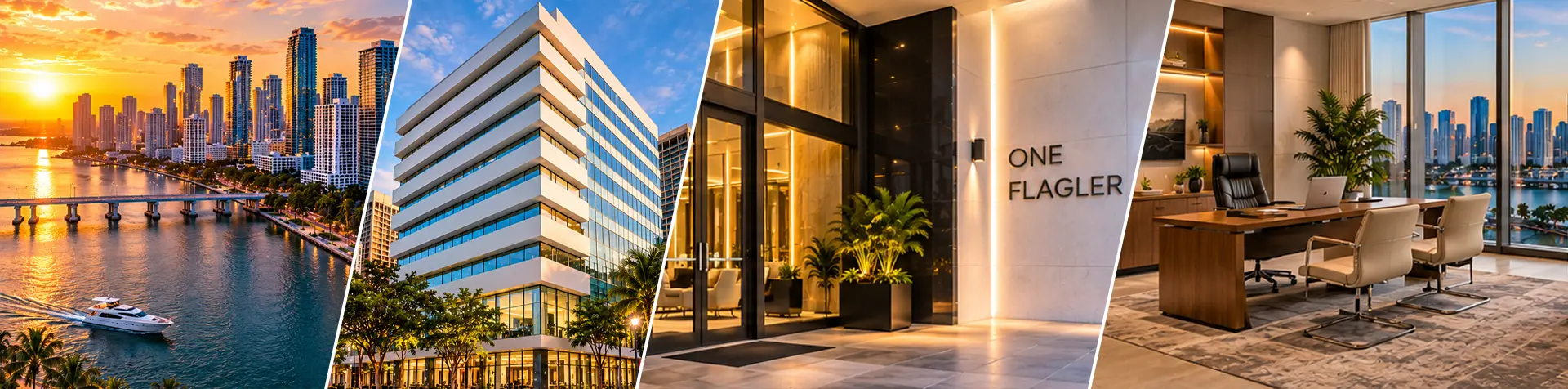
OnScientia has relocated its headquarters to the One Flagler Building in Downtown Miami. The move marks a new chapter for the academic publisher, bringing its international outlook into focus against the backdrop of one of the most globally connected cities in the United States. The choice of Miami, however, is anything but a coincidence.
Miami: A Strategic Step to a Global Crossroads for Business and Science
On October 5, 2026, OnScientia moved its headquarters to the One Flagler Building in Downtown Miami. The building stands on Flagler Street, which is named after Henry Flagler. His railroad reached Miami in 1896, when around 300 people lived there. In the same year, Miami was officially incorporated as a city.
In 1952, the Ainsley Building, known today as One Flagler, was completed on this street. It was designed by Morris Lapidus, who became famous two years later with the Fontainebleau in Miami Beach. The building was the first high-rise to be built in Miami since 1937. With its plain glass façade, it is one of the early buildings of the International Style, a group that in New York also includes Lever House and the United Nations Secretariat. Today, the One Flagler Building is a designated historic landmark. Its façade has been preserved, while the building’s interior has been extensively modernized.
Three Disciplines in One City
From the 14th floor of the One Flagler Building, OnScientia now looks out over a city in which business, law and health are closely connected. Business is the first place where this becomes visible. Around 1,200 multinational companies from around the world have established regional headquarters in Miami.
Where so many international companies operate, cross-border legal questions follow. Miami has therefore become a major venue for international arbitration. In a survey of lawyers from 39 countries, Miami ranks second among arbitration seats in the United States, just behind New York. In 2014, the city also hosted the Congress of the International Council for Commercial Arbitration. The congress had previously been held in the United States only once.
Miami is equally strong in health care. The city’s largest hospital has around 1,500 beds, which makes it one of the largest in the United States.
One remarkable aspect of this concentration is how often the journal’s three fields meet. A hospital is also a business enterprise, and both operate within a legal framework. A digital health platform serving patients in several countries raises economic, legal and medical questions at the same time. These very intersections, the ones at which OnScientia publishes, are part of everyday life here.
This brings the journal close to its readers. They include academics, lawyers, managers and health professionals as well as decision-makers in policy and corporate leadership. As a microcosm of a readership that faces the same questions worldwide, Miami brings them together in one place.
Where Continents Converge
Miami is closely connected to this worldwide readership in geographic terms as well. The city links North, Central and South America and the Caribbean with Europe, Asia and the rest of the world. Its international character is also reflected in its diplomatic presence. The city is part of Miami-Dade County. With around 80 consulates, the county ranks fifth in the nation among counties with the most foreign representations. For an academic journal whose authors, reviewers and readers come from every region of the world, there is hardly a more fitting hub.
The closest connections, however, are formed through people. According to the U.S. Census Bureau, more than half of the city’s residents were born abroad. Many of them maintain close ties to their countries of origin. In this way, insights and experience from Miami reach every part of the world. Researchers call this exchange brain circulation.
This is where OnScientia’s publishing model comes in. Every article is free to read under CC BY 4.0 from the day of publication. Research findings that OnScientia publishes from Miami can therefore be read and used freely around the world without barriers. In this way, the city becomes a multiplier for the journal.
A Location With a Future
The choice of Miami was therefore no coincidence. It follows from the journal’s own name: OnScientia — International Journal of Business, Law & Health. Every part of this name finds its counterpart in Miami.
In addition, the new location is visibly changing. Since 2021, Flagler Street has been undergoing a comprehensive redesign worth around 32 million US dollars. Wider sidewalks, new lighting, outdoor dining and public art are turning the historic street into a modern urban space. The section that begins at the intersection in front of the One Flagler Building opened in March 2026. The region continues to grow as well. According to the U.S. Census Bureau, the population of Miami-Dade County has risen by almost four percent since 2020 to around 2.8 million people.
With its move to the One Flagler Building, OnScientia opens a new chapter. The new location reflects what the journal stands for and is itself steadily evolving.

Prof. Dr. Mathias Kunze

OnScientia Opens Call for Papers for Volume 1, Issue 2
OnScientia has opened its call for papers for the second issue of its first volume, and for the first time, manuscripts can be submitted directly through the journal's new portal....

OnScientia Launches Its Journal Portal
The OnScientia portal is now online and brings readers, authors and reviewers together in one place, from the first research idea to the published article. For researchers, however...

OnScientia Opens Call for Papers for Its First Issue
OnScientia has opened its call for papers for the first issue of its first volume, and the inaugural edition is not limited to any particular topic. What qualifies a manuscript for...